
Permaculture 101: What is it and why should you care?
Happy April, Friends!
While I have been familiar with gardening practices my whole life, there is so much more that I wasn't aware of until recently. Permaculture. Yeah, I am SUPER jazzed about this and most people's eyes glaze over or they ask, "what is permaculture, anyways?!"
So, what is permaculture and why should you care?
Permaculture is a holistic approach to designing the land and home where a family can have the most sustainable lifestyle on a household level with minimal impact made on the earth and nature around us. Permanent agriculture considers purposeful functions and sustainable methods for the design of property, along with the production of food. Though, as I’ve learned, it is not limited to simply food, but a web of useful ecosystems and diverse organisms that can be used for fuel, building, medicine, community sharing, tools, and so much more. This is crucial for future generations, as the majority of us now are well aware of the damage that can be created by not caring about our consumption habits, our agriculture practices at large, and how disconnected communities are becoming from nature. I love the term, “thrival,” that I read in one of the best books ever on permaculture, and I love it because it means “to thrive, not just survive.” There’s another quote by Wendell Berry that stresses the importance of our oneness with nature, and that is, “Nature includes us....We are in it and are a part of it...if it does not thrive, we cannot thrive.”
After reading up on more than ten different books circulating the library over this winter, I found a few favorites that I would highly recommend to anyone interested in learning more about permaculture and small-scale gardening. The term, “permaculture,” was coined by an Australian teacher and scientist, Bill Mollison. Introduction to Permaculture, by B. Mollison, is a fantastic starting point for any newbie. My mind was simply blown away by the application of age-old methods in a modern world. It is a fantastic resource for small-scale farmers and home gardens, as well. Mollison focuses on key permaculture principles (relative location utilizing zones, efficient energy planning, use of polyculture, edge/pattern) and makes it easy for any reader to implement his ideas on permaculture functions into any design. For example, anyone can use biological resources to improve current conditions in a number of ways. Mollison weighs in on animal tractors, pest control, and fertilizers like comfrey and legumes, just to name a few.
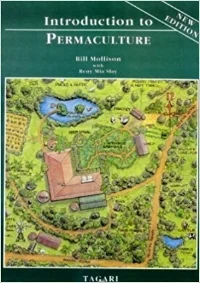
Bill Mollison's, "Introduction to Permaculture" is a great start for any new gardener or small-scale farmer.
Another fantastic resource, written by landscape designer Jessi Bloom and permaculture expert Dave Boehnlein, is the book titled, “Practical Permaculture for Home Landscapes, Your Community, and the Whole Earth." The authors cover all the bases: the basics, the design process, permaculture systems, useful plants, and delve into ‘invisible’ structures. There are many factors to consider in the implementation of a design of a home. For example, a family must consider structures, kid space, garden beds, and maybe even space for pets and backyard animals. Plus, depending on location, a homeowner may be working with existing structures or designing anew. Utilizing the principles of permaculture, whether it is in regards to water, waste, shelter, energy, and structures can help any homeowner live more in alignment and harmony with nature and the local ecosystems.
What are the principles of permaculture? In a condensed version from a number of resources (Mollison's Intro to Permaculture or Toby Hemenway's Gaias Garden were my faves):
1. Observe. Take time to notice subtle changes through the seasons before implementing any design. 2. Connect. Connect with nature, neighbors, local resources. 3. Catch and collect energy and materials. 4. Each element in a design has multiple functions. 5. Each function is supported by multiple elements. 6. Least amount of change for the greatest effect. 7. Small-scale intensive systems. 8. Optimize edge. 9. Collaborate with succession. 10. Use bio + renewable energy resources. 11. Turn problems into solutions. 12. Get a yield. 13. Biggest limit to abundance is creativity. 14. Mistakes are tools for learning.
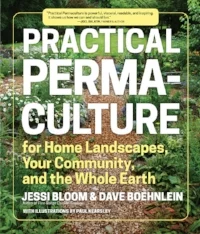
This is, hands-down, my favorite book on permaculture practices and design methods. All-encompassing with great details on how-to's, useful plants, and more.
Peter Bane, author of Permaculture Handbook for Town and Country, is one of the best teachers of North American permaculture. He focuses on the transformation of suburban and peri-urban allotments, and he shows how the elements of permaculture can produce extremely beneficial outcomes for our society at large. He approaches “garden-farming” with permaculture principles, considers the elements (think labor, water, soil, plants, structures, energy, trees), then lays out the potential outcomes. Huge benefits include improved diets, better agriculture practices, inclusive culture, tight-knit community, improved outreach, and change to outdated methods and beliefs.
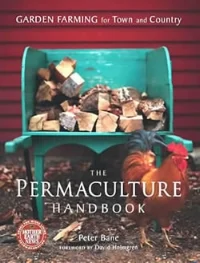
Peter Bane's, "The Permaculture Handbook" is HUGE for North American garden-farmers. This resource is fantastic for the suburban gardener who wants to transition their lot to a more productive garden space.
For over fifteen years, my passion has only grown for sustainability, renewable energy technology, ‘bio’tecture, organic gardening methods, and improving the standard of living for all. I care deeply for the earth, I hope our great-grandchildren have a beautiful earth to thrive on, and I want our community (the whole earth, really) to thrive just as much as we do.
Please refer to our Resources page for future links to great guides on small-scale gardens, design, permaculture, organic gardening, sustainable architecture, and more. The desire to learn more will never cease, so surely there will be more books and online resources that I will share with you all!
Thanks for reading and an abundance of joy to you,
G