

Blog
Let's face it, many of us living in the urban jungle can't break away from the modern city centers and its conveniences to move out to the rural, green acres, buy land, and begin a commercial-scale farming production.
What we can do, however, is pull community resources together to utilize small-scale gardening practices that help us become more resilient and reliant on a household/community level. Whether it's in your backyard, your neighbor's (with permission, of course), or down the lane at the community gardens, families can have fun growing fresh food for their family right in the city or suburb. Patio gardens are excellent for apartment-dwellers, and they are extremely low maintenance! All you need to do is Water It With Love!!
Don't have a greenthumb? That's okay! Maybe you'd like to start but don't know where or how...
It's okay! As they say, baby steps are still movement! We love sharing our knowledge on how-to's, so stay tuned to our blog posts. With over 40 years of experience in food and herb production between Gayle and Eric, we'll provide great tips on when to plant, how to plant, what tools work best for diy projects, how to preserve the harvest, garden-to-table recipes, and more! Find us on Instagram @WateritWithLove for more frequent shares and videos from the garden!
The Bare Necessities: Five Essential Garden Tools for Getting the Job Done
Head into any hardware store or garden center and you’ll find yourself surrounded with hundreds, if not thousands, of tools! Tools for digging, hauling, hacking, wacking, and honestly, you’d need a warehouse in your backyard to contain it all. So, what do you really need if you want to become a DIY gardener? Here’s a handy list to take to the shop or resource organization. Thrift shops, garage sales, craigslist, and resource centers like Resource Central of Boulder, Colorado are all wonderful places to seek out used tools at a fair price.
Five essential tools for the DIY gardener:
Hori-hori Knife. Japenese for ‘dig-dig’, this garden tool is the most handy small tool one could have for the job
Stirrup Hoe, more specifically a looped-blade action hoe
Short-handled Spade
Broadfork
Pruning sheers
Read on to learn more about these essential garden tools.
Hori-Hori Knife
I personally use this tool for EVERYTHING garden related, such as weeding deep roots, digging small holes for transplants, and clearing old growth. I may even, at times, wield it like a mini-machete, making me feel mighty powerful in my little garden world. $20-40

The number one garden tool for the DIY gardener.
2. Stirrup Hoe

This bad boy will clear the surface of the soil in minutes. Great at removing young weeds from the top layer and can be used as a quick tool for spreading out soil that has been disturbed. If planting long rows, this tool can be turned to the side and used to create the space for seeds to go. $30-60
3. Short-handled Spade

For the shorter crowd in the garden world, the short-handled spade is a great tool for digging. At 5’5”, it is easier to maneuver than the long-handled shovels, because short spades allow you to get your body weight over the handle; in turn, making things a bit easier by having leverage at a lower height! If you’re going to dig, why not make it a bit easier on yourself? $20-40
4. Broadfork
Ever hear of this tool? I didn’t until six years ago when we first went to the community garden! It looks like a wide, pitchfork that you use as a shovel rather than to pitch things. This incredible, powerhouse of a tool actually does a better job at aerating the soil than tilling and is a wonderful alternative to gas-powered tools in the garden. Many people from around the world suggest no-till methods, because tilling degrades soil life over time. Broadforks gently loosen the soil, allowing the gardener to remove and add what’s needed. We use the broadfork for removing grassroots and for adding leaves to the annual vegetable gardens. $150-250

Meadow Creature Broadforks of the U.S.A. are some of the best made products in this industry. The photo above provides a link to the “People’s Broadfork - 12” tines. You can find a video on how to use this product on their product page.
5. Pruning Sheers

Don’t be scared to prune! Some plants LOVE your attention and would do better if you gave it a little clip every now and then. Go ahead, watch a few pruning videos and then practice on a plant that doesn’t care to be whacked back (like mint or oregano). From pruning small shrubs and roses, to cutting back a 20x15ft. patch of mint, pruning sheers are a must. $25-55
You can go crazy with the tools for the garden. If that’s your style, then by all means, go for it. But for those who just want to be able to get in the garden and get the job done quickly, without spending half the day rounding up the appropriate tools, then just refer back to this list. The five tools above should be able to get just about any job done.
Organic Fire Cider Recipe
Quick and simple fire cider recipe made from organic ingredients.

How to make organic fire cider
Fire Cider has been fermenting for four weeks and is just in time for use.. my family is getting the seasonal cold going around the community, and I've got the biggest weekend coming up. There's simply no way that I can get sick! Not with this magical ‘elixir’ of sorts. Once again, I’m going to put this old, folk remedy to the test. I’ll post below on the results!
Super easy to make-- check it out--
The Ingredients:
Apple Cider Vinegar (at least one quart)
1 large onion
4-6 cloves of garlic
1 inch chunk of fresh ginger
1/2 inch chunk of fresh turmeric
1 tsp black peppercorns
1 spicy pepper - chili pepper, jalapeno, or habanero depending on how much spice you like
1 whole lemon
2 inch chunk of fresh horseradish
honey (to taste if desired)
Other ingredient options: calendula, rosemary, oregano, cinnamon, sage, tulsi basil, thyme, star anise, juniper berry, rose hips, elderberry, cayenne pepper, clove, mustard seed, and orange peel.
The Process:
In a large glass jar, add roughly chopped turmeric, ginger, garlic, onion, habanero pepper, lemon juice and peel, black pepper, and/or any other healing ingredients. Leave enough room on the top of the jar so that the vinegar can cover the ingredients.
Then, top with organic, raw apple cider vinegar. Shake the jar daily or as often as you remember! Let sit unrefrigerated for 30+ days to ferment. Top off with vinegar as needed.
After fermenting for at least 30 days, strain and remove the food/herbs, then (if desired) add raw, local honey to the cider. The cider can be bottled into smaller jars using a funnel. The remnants of garlicky goodness can be composted or put through a second fermentation process.

Shake it up, baby! After week 3, this fire cider was looking stewed and fiery!!
Organic, raw apple cider vinegar can be purchased in one-gallon containers from natural grocery chains like Sprouts market for approximately $15 (priced in 2019).
How to Use:
Some folks take this remedy for preventative measures, as it contains many anti-inflammatory, anti-viral, anti-bacterial, and immune-boosting ingredients. It serves as a digestive aide, stimulating the system and promoting an alkaline state in the digestive tract. It can also be consumed in small doses upon onset of sniffles, sneezing, cough, or congestion to stimulate the lymphatic system. It has been known to speed up the healing process to many ailments.
Fire cider can be mixed into tea, water, taken straight, or with food. Salads and sautéed greens are two types of foods you can add the vinegar to!
Storage: Once filtered, cider can be stored in glass with a tight lid unrefrigerated for up to 6 months-1 year, if not longer. If you are concerned about the product going rancid after a period of time, store it in the fridge to help prolong the shelf life of this magical elixir.
Results: Tried and true, time and time again! This isn’t my first rodeo (flu season), and I’ve had various forms of this wondrous remedy over the past ten years. It’s true. Fire cider burns like fire, and it’s so spicy from the garlic, peppers, and onion, that you wonder why the hell you are doing it.
But then, the next morning, you wake up without that severe sore throat that kept you moaning in bed the day before. My husband drank the small bottle pictured on the left over a course of 3 days and his sinus infection and bronchial issues are down to a minor cough.
This may not be the cure-all for every person suffering from the cold or flu (if special treatment is really needed, get to a healing practitioner), but there is something to be said for plant-based medicine fermented in ACV. I’d love to hear if you try it out, and if it works kicking those cold bugs to the curb!
Cheers to warming the belly, fire side!
G

Mashed-Fruit Jam Recipe
Small-batch jam recipe with organic mashed fruit

A friend calls yesterday and says, "Quick, can I stop by to give you some organic, locally grown plums that were gifted to me?" She had more than she could ever use and wanted to share the abundance. Super ripe, super delicious plums... so of course I had to make a jam!!
💗💗💗💗💗
To make mashed-fruit jam:
2 cups of fresh fruit, cut into chunks and pits removed
1 tsp. lemon juice
1/2 cup raw sugar (honey or sugar replacements work, too)
1 tsp pectin (pamona's universal pectin is the brand I use)
1 tsp. calcium water that is packaged with the pectin. This helps activate the pectin, but may not be necessary for quick jam if you don't have it in your pantry.
Set aside 3-4 clean (sterile), small glass jars and lids. Have a blender/processor ready for any thick-skinned fruit that might need extra blending (think apples, plums).
In a medium sauce pan on medium-low heat, add fruit, lemon juice, and calcium water. Mash and cook for 5-7 minutes; stirring frequently. While that is cooking, mix sugar and pectin together.
(If the fruit needs extra blending, this is the time to pull the mixer forward and use it. The vita-mix works great for hot foods. Once blended to desired consistency, pour back into the sauce pan and bring back to a boil.)
Now, the mashed fruit should be tender and... well, mashed. Add the sugar-pectin mix and stir vigorously for 1-2 minutes while the jam returns to a boil. Once boiling, remove from heat.
Pour jam into sterile jars 1/4" to the top, wipe the rims clean, then tighten lids. If canning, boil submerged in water for 10 mins. (Add 1 min. for every 1000 ft elevation change) Remove from water and allow to cool. Check the seal. Then, store until you can't resist eating it any longer.
If you don't want to boil jars, place cooled jars in the fridge and use within 3 weeks.
💗💗💗💗💗
Fermented Ginger-Apple Beer
Recipe for fermented ginger beer and fresh apple cider
Fermented Ginger-Apple Beer
This past month in my permaculture design course, we learned all about fermentation.. and the bug hit! I immediately knew my sourkraut making days were now going to include kim-chi, fire cider, kombucha, ACV, and what else?! Ginger. Fermented ginger is EASY and even better that this bug hit me while it is apple season. Oh, Fall - with the glorious abundance of apples, plums, apricots, Palisade peaches, and more! Apple Cider is amazing and quite simple. If you don’t have a cider press, juicing is a good way to enjoy the fruit, too.
Let me get to the point— When you put two good things together, what do you get? Amazing!

Fermentation complete.
Caution: Consume at your own risk! Extremely delicious flavor inspires immediate and possible overconsumption.
Ye be warned!
Check out this recipe on how to make a ginger bug, then go on to feed fresh apple cider to it during the 2nd fermentation. The end result? Heaven in a bottle.. yes, if heaven could be bottled, this is what it would taste like.
How to make a ginger bug:
In a medium glass jar, mix 1 tbsp. minced or grated (*must be unpeeled) fresh ginger, 1 tsp. raw sugar, and 1/3 cup water. Cover jar with cheesecloth or coffee filter, then set on counter for 24 hours. Stir when you remember to! After 24 hours, add minced (...or grated) 1 tbsp. unpeeled ginger, 1 tsp. sugar, and a bit of water. Stir, cover, and let sit at room temp. Continue to add and stir every day, and after 2-3 days, you'll see fermentation occur.
*The outer layer of ginger, the brown peel, is what contains the naturally-occuring yeast and bacteria needed for fermentation. Please consider buying organic ginger when making your own.
This is when you can add the ginger bug to fresh pressed apple cider. In a large glass jar, mix 1/2 cup ginger bug to 1/2 gallon cider, plus 1 tbsp. fresh slices of ginger; peeled. Allow that to ferment for 2-5 days at room temp with cheesecloth cover; stirring daily and keeping it out of the light. Filter with the cheesecloth as you bottle into jars that can be 'burped' for 2-3 days. This is when the apple-ginger beer develops carbonation. Store in the fridge after fermentation is complete.
Recipe is loosely based on another version by Grow Forage Cook Ferment.
Gayle's Rough Guide to Growing Organic Garlic
Happy Summer!
How can it be the end of August, ALREADY?! Where did July go?! Forget that, where did June go???!!! In the garden, we've had a bounty of fresh veggies, the sunflowers are 10 ft. tall and feeding American Goldfinch, plus our garlic and onion harvests have been put away for autumn/winter meals.
We've been diversifying our organic seed selection, along with saving seeds from our homegrown food. Garlic is one of my all-time favorite foods to grow, and it's one that we continue to save and plant generation after generation every year. It is a medicinal food that is a staple for many families around the world, having been cultivated by humans for over 5000 years! It is extremely versatile across many cultural meals, but not every gardener knows where to begin or what to do once it's harvested.
Welcome to Gayle's Guide to Growing Garlic!
In this blog, I will cover:
Garlic varieties (hard vs. softneck)
Getting the ground ready
Golly! Autumn Cultivation (had to do it!)
Garlic maintenance - mulching, fertilizing, watering
Garlic harvest
Garlic braids, curing, and storage
Garlic seed saving (bulbil vs. clove)
By the end of this blog post, you should have a general understanding of how to grow your own! And of course, it always helps to simply water it with love. Meaning, put thoughtful (loving) intention behind your actions, and you should see a fruitful harvest!
GARLIC VARIETIES
To begin, there are MANY varieties of garlic grown around the world. Cold conditions, wet/dry/hot...garlic grows in abundance! There is even wild garlic. But really, hardneck, softneck.. what does it all mean?
Hardnecks produce approx. 5-10 large cloves with a scape, while softnecks produce many smaller cloves (12-24) and usually forego the scape. Hardneck garlic is great for roasting and baking, and it grows well in cold/wet conditions. Softnecks pack strong flavor, so they are great for cooking, sauces, fermentation, and eaten raw. Yes, I said raw. Softnecks are known to grow well in hot/dry conditions.

Homegrown Inchelium White softneck garlic harvested Summer 2018.
Easily enough, anyone can plant any garlic clove directly into the soil, and they will get a full, new bulb in the next year. No need to seed save from the hardneck scape (more on that later). No need to go to a seed supplier every year, unless of course, new specific varieties are desired. Simply plant 10 separate cloves, and 10 bulbs will grow!
Try out some of the few suggestions below and see what works for your specific garden and cooking needs.
Hardneck favorites: Spanish Roja, Chesnok Red, German Stiffneck or Extra Hardy, Zemo, and Music. Check out High Mowing seed company as an example of delicious varieties of garlic from an organic grower.
Softneck favorites: Inchelium Red, Lorz Italian, Early Purple Italian, and Broadleaf Czech. Seed Saver's Exchange is a wonderful organization dedicated to preserving organic and heirloom varieties of North America.
I also highly recommend exchanging garlic varieties with neighbors or local farmers. If a neighbor or local farmer grows garlic annually, the garlic will adapt to the climate, precipitation, and regional soil conditions - making it hardier for your own garden. However, in some cases, like volatile swings in climate or seasons with higher cases of pest/disease exposure, shared garlic seeds and harvest may be negatively impacted.
GETTING THE GROUND READY
Soil conditions. One thing that we must discuss before you just toss those garlic cloves in the ground, water it with love, and hope for the new crop next July! If anything, this is the most crucial factor in gardening success. Many people feel defeated and throw in the trowel when gardening just doesn't work, so let's set you up for the best chance of success! Here is a simple step-by-step on ground preparation.
1. Mark out the garlic bed. Growing 20 garlic heads? 10x2 ft. bed will suffice with room to plant other herbs or veggies in the mix. Remember, companion planting helps reduce pests, weeds, and increases overall diversity in the garden.
2. Add organic matter. Say it with me --- "AOOOOMMMMM." Think leaves, compost, animal manure, green manure, and worm castings. The top 8" of soil needs to be ready for growing. Try sheet-mulching, which is discussed in What Feels Like Spring Greetings. Later on, investing in a high-quality, organic fertilizer may be important.
3. Mulch. Top dress the soil with straw, leaves, spent hay, grass clippings from a pesticide-free (all -cides free, really) lawn. Mulch reduces erosion, opportunistic plant takeover, increases water retention, and helps protect against harsh conditions over winter.
4. Let rest. If you're going to add a heavy dose of organic matter like leaves, grass clippings, or green manure, amending could begin 6-8 weeks prior to planting out garlic. This is where mulch is crucial, because it keeps soil healthier by reducing sun exposure to the organisms in the soil, allowing them to do the "dirty" work on breaking down the matter that becomes garden gold.
Now, you are ready to plant!
AUTUMN CULTIVATION
Surprisingly, garlic is one crop that is planted in the Autumn and harvested the following Summer. Depending on your zone of hardiness, garlic is planted around the first hard freeze. For Colorado residents, early October is the most common time to plant garlic. If the first hard freeze is in September, plant in September. If your region does not freeze, consider checking with farmers in the area to confirm when it's the best time to plant.
In your freshly amended garden bed, create two rows that are 12 inches apart and 3-4 inches deep. If regional climate patterns indicate severely cold weather for the average winter, plant 4 inches deep with a mulch layer on top.
Plant garlic cloves 8-12 inches apart in the two rows. Every garlic bulb needs 4-6 inches in all directions to grow nice and large - so space them out!! If there's extra space around them in the Spring, lettuce, chard, celery, kale, parsley, basil, thyme, or cilantro could be planted intermixed along or between the two rows.

Removing the mulch revealed fresh green sprouts in early May!
Once the cloves are in the rows, cover them up with soil and mulch, mark the rows so you remember where they are, and allow them to lay dormant through the Winter season. By March-May of the following year, green tops of your baby garlic bulbs should emerge! Yahoo! You did it!! It's so gratifying to see the garlic tops come up, because you know - right then- you'll have something to harvest, and you can happily continue on with plans for other crops.
If garlic doesn't come up in the spring, that's okay. Mistakes are great learning opportunities, so try to troubleshoot any past mistakes or seek assistance from a friend, neighbor, or local farmer. Farmer's markets are a wonderful way to connect to people 'in the know'! You can even email me through the contact page on this site.
Growing garlic in a container? In one large barrel gardening container, plant 4-5 garlic cloves equally spaced out around the edge, leaving 4 inches of space between the garlic and the pot. Planting depth and spacial needs remain the same when in a container. Then, in the Spring, consider planting 1 determinate tomato plant, 2 eggplant, or 2 pepper in the center of the pot. Perennial herbs like sage, oregano, and rosemary are wonderful companions, as well.
GARLIC MAINTENANCE
Mulching - Keep the ground covered to help retain moisture and reduce soil erosion. Straw, leaves, spent hay, comfrey cuttings, and green ground covers, like clover and legumes, work great.
Fertilizing - If you are going to use fertilizers, please consider the source. According to many gardeners, garlic needs a few doses of plant food aka fertilizer to give them a good boost of supplements in the early spring. Some say once per week, but I saw wonderful results with a bi-weekly dressing, then slowly reducing the frequency as we approached the July harvest time. Follow the directions on the fertilizer bottle for the ratio on fertilizer to water that you will use. Usually, gardeners use a watering can/pitcher to mix the fertilizer with 1-2 gallons of water that will then be poured over the crop. I like to water the plants after fertilizing to give them a good soak and spread that fertilizer out and into the soil. Happy, happy!

Neptune's Harvest Fish Seaweed Blend 2-3-1 is a fantastic fertilizer for all of your gardening needs. Not just garlic, but onions, leafy greens, squash, and melons all LOVE this product. I am not here to sell anything, but I swear by this organic fish/kelp fertilizer. Age Old organics is a beloved brand around here in Colorado, but if you look closely on the back of the bottle, it says it is not for use on organic crops. Hmm...?
Watering - Utilize Spring precipitation. Don't overwater, but don't allow them to dry out completely, either. How do you know if your soil is wet or dry? The Soil Test, of course! If you stick your finger in the soil 1-2 inches deep, it should feel damp. If not, water it!! The garlic won't need attention over winter, but as soon as the snow melts and the greens pop up, it's time to pay closer attention to your crop.

Over the course of Spring, you will want to water frequently, however, near the end, as the garlic is beginning to put most of the energy into the bulb of the plant, watering is not needed as often. If you have planted other veggies or herbs around your garlic, focus the water on them rather than soaking the garlic. It's important to allow the garlic to dry out in the soil, or it will be more prone to fungal diseases like garlic rust.
Preferred watering methods are open for debate - many LOVE and highly recommend soaker hoses and drip systems. They reduce evaporation and wasted water, they minimize mold and mildew issues on prone plants like tomatoes, plus they're easy to set up and easy to use on a timer. My 15x30 ft. companion planting/perennial/annual/individual-need plants require attention that a drip system wouldn't be best for. In this case, I prefer a gentle-flow nozzle that distributes 4 gallons per minute. Fogg-It nozzles, for example.
A few tips for watering with a hose: Aim close to the soil, not in the sky! Also, avoid watering the leaves of most types of plants, as this will reduce mold, mildew, and pest infestations.
GARLIC HARVEST
Now that the garlic has been tended to for the Spring months, there should be real, honest-to-goodness, garlic in Mid-June. The bottom leaves should start to turn brown, and some of your stalks may start to fall over. If there are hardneck garlic varieties, you will see the scape form from the center of the greens at the top (again, more on this later). The Summer Solstice is an interesting time in the gardening/farming world, as well as, the moon cycles. Personally, I like to tune into the weather patterns, moon cycle, and significant dates to see when it would be best to harvest.
When you think the garlic is ready, test one bulb to see. Gently pull the whole plant up from the soil. If it feels tough to pull, loosen the soil with a trowel or shovel; careful not to strike the plant with the tip of your blade. Gently remove any excess soil from the roots and lay your garlic out on the top of the soil. If you feel the garlic is ready to harvest, continue with the rest of the crop. If not, wait another week or more, then try again.


GARLIC BRAIDS, CURING, AND STORAGE
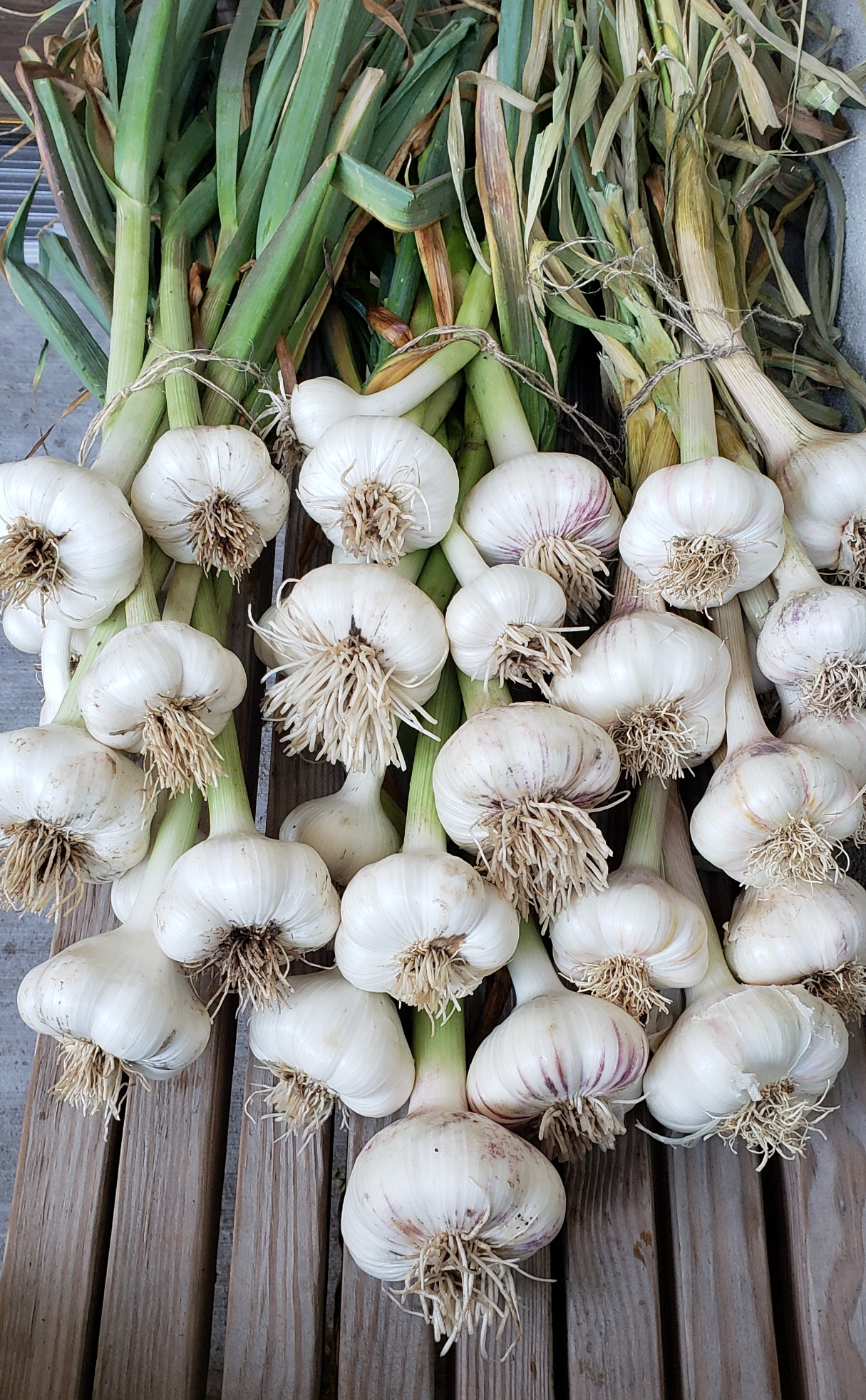
Harvesting garlic is one of the most rewarding experiences in the vegetable garden. Once you've grown garlic, it's extremely tempting to gobble it all up in a roasting pan, pesto, and sauces. However, garlic needs to cure, or dry out, for at least 30-60 days. We can't resist, so yes, some green garlic is consumed immediately!! But then, once I've shaken off most of the soil from the plants, I try to clean them up to braid for curing.
Here are how-to videos on cleaning and braiding garlic. This season was our first time growing three varieties, two of which are similar softnecks and then one hardneck that my neighbor has saved for 16 generations. We braid garlic to make it more efficient for the curing process, however many people do a tight braid for hanging all winter long. I don't personally keep my garlic in braids, so this version of braiding is more for temporary purposes. My apologies to those who are looking for the tight garlic braid, but as I said, I'm not the only one growing and storing this plant, so I suggest a quick YouTube search on how to braid garlic. You'll find wonderful resources from other gardeners!
Garlic loves to be cured in a cool, dry place, preferably out of direct sunlight. Braiding garlic makes storage easier, because it should be hung from the greens to allow the remaining energy to go into the bulb during the curing process. Once garlic has cured for 1-2 months, meaning the leaves have wilted and dried completely, it is ready to store for Autumn/Winter meals. Simply brush off the dried leaves and layers that are loose. The long tendrils of leaves will break off pretty close to the bulb. Then, take the garlic harvest and store in a cool, dry place. We have a storage box for onions, garlic, and potatoes.
Unpeeled garlic has great shelf life. Softnecks are said to store for approx. 6-8 months. Hardnecks should store longer; some say up to one year. Peeled garlic lasts one week in the fridge, so keep it whole and unpeeled until necessary.
I do not leave dirt on the garlic after harvesting, as it can mold from moisture, especially when hung garlic is touching other bulbs. Some farmers/gardeners leave dirt on and then brush off when it’s done curing. A personal preference, here.



SEED SAVING BULBILS VERSUS CLOVES
A scape, as I try to explain in the video, is the garlic going to 'flower' on the hardneck varieties, though it's not actually a flower producing seed. If you allow it, the scape will produce bulbils, and they are technically the clone of the parent plant. According to my garden neighbor who has seed-saved for 16 generations, it will take him one year to grow the bulbil to be a full-size clove, which will then go on to produce a bulb in the second year. According to multiple sources, bulbils should be stored dry and need to undergo stratification, which means they need to experience cold temperatures before they'll grow into bulbs.
Bulbils are smaller cloves in the first year and can be planted much closer together. Also, they don't get planted as deep; one to two inches for the first year, then 4-6 inches on the second year. After the first year harvest has cured, save the cloves for the following year's real bulb harvest.
However, if you are growing garlic to eat the bulb, then pinch the scape off as it begins to curl at the top of the plant, otherwise the energy is going into producing the bulbil rather than growing the bulb nice and large. The scapes go great in a salad or pasta/pesto sauce...just sayin' DON'T TOSS THEM - EAT THEM! Typically, this process occurs mid- to late-June.
Thinking about planting more garlic for next year? Great! Take one or two of the harvested garlic bulbs, separate the cloves, then go back to step one of this entire process. The clove should be hearty and healthy enough to grow into a new bulb next Spring.
SO-LONG, FAREWELL
As I said, I simply cannot believe that it is nearing September. We have harvested beets, carrots, herbs, tomatoes, corn, eggplant, bouquets of flowers, zucchini, gourds, tomatillos, rhubarb, onions, radish, peppers, and so, so much more. We are beyond grateful for the opportunity to grow food and medicine in a community garden space while we are apartment-dwelling in the city. If you desire a space of your own, but don't have access to one, I would encourage supporting the cause to get a community garden going in your city/town/village/neighborhood/apartment HOA. Visit your town hall or HOA meetings to discuss the opportunity to find a park or open-space to adopt a greenhouse/community garden center. You would be SURPRISED at what a group of 50-100 gardens can do for a population! I know, firsthand, that a 15x30 ft. space can feed a family of four fresh food daily from May to October, plus a great bounty for Autumn and Winter meals. Gardening is good for the soul and it helps improve health of both human and Earth. Get out there and dig it!
Don't forget to water it with a little love :)
Gayle


The garden progress from May to August!
References:
Morrow, Rosemary. Earth User's Guide to Permaculture. 2nd Edition. Published 2006.
Sheet-Mulching can be found in wonderful resources such as Gaia's Garden (see Resources page for more info)
Expertise from multiple garden neighbors over the course of 4 years of being in the community garden. Even longer when you consider family traditions or friends that we've worked with who have shared their knowledge. There's nothing like tradition and culture being passed along through communication within our communities, and then having storytellers, like me, be able to pass the info along to other people, whether they are here in Colorado or abroad.